

Chapter One: The Spore of Dread
It All Begins Here
March 24th, 2027
The vibration against the bedroom nightstand is subtle, a low hum threading through the stillness. It doesn’t shatter the quiet; it infiltrates it. Brandon Robinson’s hand moves before his mind fully wakes, his instinct guiding him to silence the 4 a.m. alarm before it can disturb his wife, Mary.
She lies next to him, sleeping soundly; her warmth is comforting beneath the blankets. The rise and fall of her chest are steady, rhythmic, and he takes a moment to listen, memorizing it the way he always does before rising.
Slowly, he gets up without rustling the sheets or making a sound. Years of early morning rising have made his routine automatic. The floor beneath him is familiar, its creaks mapped into muscle memory. He steps lightly, navigating the darkened house like a shadow.
Down the hall, the laundry room waits and the washing machine’s cool metal meets his touch as he tosses in a load. Whites today. The washer hums to life, filling the silence with its steady rhythm. Routine and discipline. The foundation of everything in Brandon’s life.
He grabs his gym bag holding his shoes, grip chalk, and weight belt. The bag’s familiar bulk settles over his shoulder comfortably. Its fabric, worn soft in places, carries the grind of years lifting, pushing, and refusing to break.
As he steps outside, the cold March air feels balmy against his skin, unusually humid for early spring. He rolls down his window as he heads out to the gym.
Driving through the empty streets of Oswego, Illinois, he arrives at the gym just minutes later. Jakked Hardcore Gym is not for testing the waters; but Brandon is no tourist. He’s been training here since 2012.
Inside, the scent of iron, sweat, and chalk dust lingers in the air, particles drifting lazily beneath the fluorescents. A barbell clangs against the squat rack in the distance, a sound that charges the room better than any pre-workout could. This is where Brandon resets. For 75 minutes, he pushes and drives his body.
At 63, they say he moves like a man half his age. He trains like one too. The barbell settles across his back, grounding him as he pushes, pulls, and drives through each rep.
A quick glance at the mirror reveals a man of 6'2", 250 pounds, and solid muscle. His head is shaved, and his brown eyes sharp and watchful. A meticulously maintained goatee adds to the edge.
Moving through his reps he sees Jerry, a gym regular, approaching. He gives him a quick nod.
“Looking pumped today,” Jerry comments, pausing for a few seconds to watch Brandon lift with precision. “Must be something in the water.”
Brandon flashes a smile but keeps his focus as he lowers the bar.
“Just doing what I do.”
Jerry chuckles and moves on to the next station.
Brandon locks himself in for his last rep. The burn in his muscles is sharp and familiar, exactly the kind of reset he needs. He has no plans of slowing down. Not yet.
When he returns home and steps through the front door, the sun barely breaks the horizon. He pauses as he immediately senses something feels different.
He smiles. Mary is awake. She’s never up this early.
Mary flitters through the kitchen lost in thought. Her auburn hair sways back and forth as she moves between the counter and the fridge, and her bare feet shuffle softly against tile. Her purple bathrobe drapes over her petite frame, the hem sweeping the floor as she paces.
Brandon watches her for a moment. He knows that look on her face; there’s something on her mind. He sneaks forward and grabs her, wrapping his arms around her from behind. She lets out a sharp gasp, and then a startled shriek.
"Brandon!" she cries, her pale blue eyes flashing wide as she jolts in his arms. "Don't do that!"
Even as she scolds him, laughter threatens beneath her voice. Brandon chuckles, still holding on.
"You're up a little early," he notes. "Everything okay?"
She turns in his arms, giving him a tight hug before pulling back, her hands moving instinctively to her hips.
"I told you, honey," she chides, shaking her head. "Anna wants to do some shopping today. I promised her I'd go with her."
Anna, their 22-year-old daughter, is their youngest of three children and the only one still living at home. She transferred from UIC two years ago to a local university to be closer to home. To say she’s still attached to her parents would be an understatement. But Brandon and Mary don’t mind.
"That's right," Brandon nods. "Is she up?" He pours himself a cup of black coffee, no sugar or cream. Anything else would be an insult to the drink itself.
"Not yet," replies Mary. "I’m getting her up in a half-hour. You'll be gone."
Brandon nods as he sips the coffee. The bitter heat settles into his bones as he rubs his hand along the long butcher block island that he and Mary installed together. Just one of the many home projects they’ve taken on over the years.
Usually, mornings are Brandon’s few precious moments of solitude, before his phone begins to ring, emails flood in, and the problems of another long day demand his attention. But seeing Mary before he leaves offers a rare kind of comfort. He’ll take it.
Like his early mornings, evenings are also sacred. Dinner out at least twice a week with Mary, often joined by their closest friends, James, an astute alarm specialist, and his wife Valerie, a budding freelance artist. Tasty food, great conversation, and the occasional indulgence in Michelob Ultra®. He watches his carb intake, but not at the cost of enjoyment. Life is about balance.
At 10 p.m. sharp every night, it’s lights out. Like his daily workouts, sleep isn’t negotiable. Efficiency requires rest and he needs to be sharp. Because, when morning comes, the cycle starts again.
At 7:30 a.m., Brandon climbs back into his silver Tundra truck and lets it roll quietly down the driveway. He grimaces as he notes how the normally cool March air is oddly humid as it brushes across his face through his open window. He drives three miles to his modest 4,000-square-foot workshop just across town.
Another safe haven.
Like his home, Brandon enjoys the familiar atmosphere of his shop. While not fancy by any means, it holds everything a man could need to run a successful mold remediation business. After more than two decades of removing mold from homes throughout Chicagoland, his company, TrueCore Indoor Environmental, is among the most trusted names in the industry, and the number one remediator choice of homeowners, realtors, and commercial businesses.
Further, his independent research on mold keeps him in demand by trade schools looking to give students a competitive advantage, as well as lawyers seeking expert court testimony.
Entering his shop, he looks around swiftly and smiles slightly, revealing his feeling of contentment from the life he built. He begins to whistle as he grabs a bottle of water from the mini fridge a few feet from his large desk and settles comfortably into an ergonomic chair.
Then, he frowns as he wipes several beads of sweat from his brow, his calloused fingers momentarily pausing over a stack of papers. He shakes his head to shift his thoughts back to the many estimates and RFPs covering his desk, again carefully sifting through them.
From a large multi-paned window on the east side of his workshop, the morning sun casts elongated shadows over the disarrayed case files, containment reports, and chemical analyses that cover nearly every inch of his sprawling work surface. To his relief, a strong breeze pushes through the slightly opened window on the south side of the shop, cooling him down and causing his papers to flutter slightly.
Taking a deep breath, he can faintly smell the industrial disinfectants that line dozens of shelves along the walls of his shop. The familiar scent mingles with the underlying mustiness of old documents that serve as records of homes he has saved from some of the most dangerous molds. Casually, he opens his planner to go over his schedule.
For no clear reason, the hair on the back of his neck prickles. Sitting up straighter he looks around his sprawling workshop but sees nothing amiss. Taking another deep breath, Brandon shakes his head and picks up a pen. But as quickly as he picked it up, he puts it down.
Maybe it’s paranoia. But Brandon learned long ago never to dismiss his intuition. And today, his intuition is telling him something is wrong. Despite his typical unwavering confidence, he suddenly feels an uneasy sensation.
*****
Across town Brandon’s field supervisor, Greg Lindenberg, also starts his day like any other. One job, one house, one basement in need of remediation.
Several days earlier, Brandon’s recent estimate in the home revealed a few patches of blackish colored spots that looked like Penicillium mold near some exposed piping in the unfinished basement. It would be a simple project for someone with experience, so he sends his best guy, Greg, to handle it.
Greg, a calm, soft-spoken Swede who towers at 6'5", has been the backbone of TruCore’s field operations for nearly a decade. He’s built like a brick wall, with hands the size of dinner plates, and a heart of gold. Not much rattles him.
Arriving at the client’s home, he unloads his equipment and carries it around to the back of the house. Brandon doesn’t allow workers to trek through clients’ homes, so the front door is off-limits. But Greg doesn’t mind. He moves on autopilot, effortlessly bringing the gear inside with quiet efficiency.
*****
Later, deep into his work, Brandon’s phone rings. He grins. It’s Greg.
“Hey, Greg. What’s up?”
On the other end Greg Lindenberg’s voice is uncharacteristically tight, clipped.
“It’s the Larkins. Something’s not right, man. They called early this morning. Panicked. I told them I’d be there before eight.”
“Okay, so where are you now?”
“Already here,” Greg says. “I-I don’t want to jump to conclusions, but I’m telling you, it’s bad. Like... well, I’ve never seen anything like this.”
Brandon feels something shifting in his gut. Not dread or panic. But instinct. His eyes move up to a window. The early light now seems strange. Maybe, too dim for this time of day.
“On my way,” he says, grabbing his protective gear. “Just stop what you’re doing. Don’t touch anything.”
As he rushes to leave, he pauses at the door. Something pulls at him. An echo of memory. Not of fear, but of certainty. This isn’t the first time he’s trusted his gut.
A decade ago, Brandon walked into a sealed luxury high-rise in Schaumburg, Illinois. The building’s home owners’ association swore there was some harmless water damage. In fact, it turned out to be highly toxic black mold layered behind every vent. He found it with nothing but a hunch, and his tools.
The press had picked it up after they evacuated the building.
Chicago Tablet, October 8th, 2019
‘THE MOLD WHISPERER’ STRIKES AGAIN
Environmental Specialist Brandon Robinson finds hidden Stachybotrys infestation in 22-unit high rise before tenants suffer permanent exposure.
“He saw what no one else could,” one tenant reported. “That man saved my daughter’s lungs.”
The framed article hangs in his office as a clear reminder that gut instinct isn’t superstition. It’s pattern recognition, sharpened by experience. He feels a similar instinct right now.
Stepping outside, the air feels heavy and damp from something unspoken. A low fog now creeps along the ground. The kind that hugs the earth like a warning.
Jumping into his truck, he flips on the radio and catches the weather report mid-sentence:
“...low-pressure front may stall over the western suburbs today, bringing unusually high humidity and patchy fog to the area…”
Brandon frowns, flipping it off. He drives in silence, his mind narrowing to the task ahead.
He doesn’t speed, but he doesn’t dawdle either. His eyes scan the roads with trained precision. Suburban homes pass by in quiet succession, but something about this morning feels like it doesn’t belong.
The air is…off. It’s too thick; too heavy. Like he’s breathing through a wet blanket.
Pulling into the Larkins’ driveway, Brandon opens his door and gasps as the air hits harder. It’s something denser than humidity. Like a film across his lungs.
Before he can knock on their front door, it swings open. Homeowner Lisa Larkin stands in the doorway; her face is pale with dark circles smudged beneath exhausted brown eyes. In her mid-forties and usually full of life, she looks gaunt, as if something has been feeding off her energy. Wisps of dark brown hair fall loose from the messy bun hastily tied at the back of her head.
A few feet behind her, her husband Ethan looms in the dim hallway, his broad shoulders slumped, his blue flannel wrinkled from wear. Mid-forties with graying hair and a five o’clock shadow creeping across his jaw, he looks as drained as Lisa does. His hands, rough from years of manual labor, clench into anxious fists.
“Mr. Robinson, thank you for coming so quickly,” Lisa says, her voice barely above a whisper. “We… we don’t know what to do.”
Ethan runs a hand through his already disheveled hair. His voice is hoarse, frayed at the edges.
“It started small. Remember? Just a few spots in the basement near the pipes. Then it just…spread. Overnight.”
Brandon studies their posture, the tremor in Ethan’s hand, and the sheen of sweat on Lisa’s skin despite the chill in the March air.
“Show me,” he says.
Stepping further into the house, the thick sensation in the air intensifies. It’s stagnant and thick and carries a strange chemical tang that’s sharp and intrusive, making the back of Brandon’s throat itch. He takes a quick look around him.
The Larkins’ home is spotless, featuring polished wood floors, framed photos neatly lining the walls, and the faint scent of lavender clinging stubbornly to the air. Yet, despite the warmth of the home, there’s an unnatural chill beneath it all.
Lisa hugs herself, and briskly rubs her arms as if cold, despite the beads of sweat running across her forehead. She gestures toward the basement door but doesn’t touch it.
“It was just a few spots the other day,” she murmurs. “Yesterday, it doubled. This morning… it’s everywhere.”
Brandon glances at Ethan. The man swallows hard.
“Like she said, it was only a few spots. But when I came down this morning…”
Brandon’s pulse quickens, but he wants to remain rational. He’s seen every mold spread situation possible, so he’s starting to feel skeptical.
“Any new physical symptoms?” Brandon asks, his tone measured. “Coughing? Dizziness? Trouble breathing?”
Lisa nods slowly, biting her lip.
“I thought it was sudden allergies at first, but it’s different. It’s like the air is—”
“Please just go look!” Ethan interrupts sharply. “Tell us what’s going on!”
Brandon takes a slow calming breath and rests his hand on the basement door handle.
“Okay, show me,” he says. But Lisa and Ethan step backward away from the door.
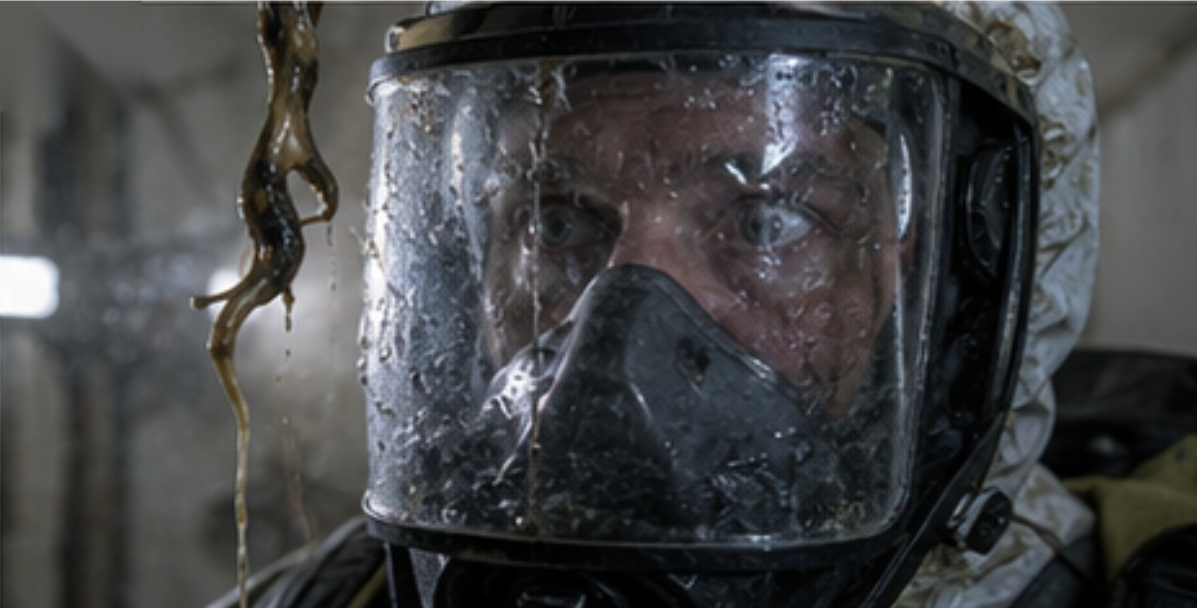
Wasting no more time, Brandon pulls on his gear, straps on his respirator, and opens the basement door. It creaks, releasing a gust of cool, clammy air that brushes his face like a wet cloth. He flips on his headlamp and starts down the dim stairway.
As he descends, the air grows denser with each step. When he reaches the concrete floor the air shifts: thicker now, almost jellylike, clinging to his exposed forehead. His breath catches as he struggles to fill his lungs. Meanwhile, he adjusts his eyes to the dark, scanning the empty space for Greg.
“Uh, Greg?” Brandon calls out, masking the nervous edge creeping into his voice.
Greg Lindenberg steps out from under the staircase, his massive frame partially silhouetted against a dim overhead bulb. But even in the poor lighting, Brandon can see his eyes are wide behind the seal of his respirator.
Greg doesn’t speak, he merely gestures, his gloved hand trembling slightly as he points toward a far wall.
As Brandon turns to look, his insides clench hard.
The white-painted cinderblock walls he last saw are no longer visible. They’re covered with thick, inky-black growths, veined and pulsing in slow, deliberate contractions. But, unlike mold clinging to a surface, these move.
With slick tendrils, fibrous and glistening, it snakes out from the corners, twisting across the ceiling beams, drooping down like the limbs of something ancient and hungry. From somewhere deeper in the basement, a faint wet sound echoes. A dragging. A shiver.
Brandon notices the smell is overwhelming. Not from a damp, earthy scent of mold; but something sharper, more corrosive. A mix of decay, metal, and chemical permeates his mask and burns slightly at the back of his throat. And, beneath the moisture of the air, there’s an electric charge, a hostile presence, that makes the hairs on Brandon’s arms stand on end.
He takes a half step back. His stomach flips; sharp nausea cutting through his gut. The urge to flee flares hot and primal. But he clamps down on it and forces a breath.
“Brandon, you see it, right?”
“I see it,” Brandon says, quieter than he meant to.
Greg’s eyes flick to the corner.
“It started as just a few spots near the pipes. I swear to God, it moves.”
Brandon takes a step forward, his eyes scanning the walls with clinical precision. This isn’t mold. At least, not any species he’s ever seen. Not Stachybotrys, not Chaetomium. The structure is all wrong. It’s not dry, flaky, or slimy. Instead, it looks structured. Like muscle fibers woven together.
Kneeling, he opens his large, battered testing kit, its surface scuffed from years of use. Inside, the familiar arrangement of items gives him a fleeting sense of control. He runs his eyes across its contents, trying to concentrate.
A scalpel set rests in foam, each blade catching the dim basement light. Sterile sample containers sit in neat rows, their lids sealed tight. There’s a Tramex™ moisture meter, ready to trace hidden water behind walls. There’s also a Firefly GT620 wireless microscope for instant spore magnification. The Temtop™ particle counter already beeps softly, a steady warning of high contamination. He picks up his UV flashlight, critical for spotting mold invisible to the naked eye.
Selecting a scalpel, he checks the angle of light and, taking a deep breath, presses the blade to one of the tendrils. He cuts, but barely.
A thick black ooze spurts from the wound as the tendril spasms, like muscle reacting to pain. The tendrils nearby twitch in unison, recoiling slightly before stiffening again.
Brandon jolts backward, his heart hammering as he drops the scalpel. The skin on his arms prickle beneath the suit. His body is telling him something before his mind can process it fully.
This basement is alive! The movement isn’t random. It’s reactive. Mold doesn’t do that, so this can’t be mold, he tells himself.
As if reading his thoughts, Greg takes a step closer, his voice more stable.
“Brandon, it started as just a few spots near the pipes. But then—”
He slowly turns to Greg, his expression hard.
“I believe you.”
“What are we gonna do?”
Brandon turns back to the wall.
“I want you to go home,” he tells Greg.
“What?”
“Clean up. Get something to eat. Clear your head. And don’t say a word. Not to anyone. Not yet.”
Greg hesitates, stunned.
“But—”
“I’ll get the Larkins out and seal the basement. After that, I’ll handle it.”
Greg nods and slowly climbs the stairs without another word.
Brandon watches him go, then crouches down again. He grabs a sterile container and collects a sample from the cut section. He needs to know what this is, and fast.
*****
Two hours later, Brandon returns to his workshop with his sample. He works in silence as he meticulously sections off a part of his workshop and creates an enclosed makeshift laboratory. The weight of the morning hangs over him.
The lab air is sterile, filtered, and controlled. It carries the faint scent of ethanol and dust. With his lab workbench now prepped, he unclips the respirator and exhales, letting the tension ease from his shoulders as his focus sharpens.
The sample sits beneath the Firefly™ GT620 microscope, sealed inside a sterile slide case. He adjusts the lens and focuses.
Immediately, he sees it and lets out a small gasp.
The spores don’t just drift; they cluster and pulse. They migrate to the edge of the slide and then retreat.
Brandon leans in, eyes narrowing. Their movement isn’t random. It’s deliberate.
“What the hell are you doing...?” he murmurs.
He increases the magnification. The structures are intricate, vein-like, with branching formations that interlock almost like synapses. This isn’t mold. It’s not a bacterial colony either. It reminds him of neural pathways.
He jots a quick note: Clustering pattern identical to synaptic grouping. Possibly signaling behavior?
The air seems to be growing colder. Not in the room itself; the air in his lungs has become shallow, uneven. Fight-or-flight reaction stirs again, but sharper this time. It’s fear and recognition.
Brandon’s seen patterns like this before, but not in living systems. Not even cordyceps, which hijack ant brains, came close.
He snaps a photo of the screen and grabs his phone to call Reed Talbot, an old EPA contact. Someone he trusts.
Reed is obsessive and meticulous, the kind to never let go of a question until it gave up its answer. They worked in the field together during that strange outbreak in southern Missouri back in 2019.
There’s no answer.
Next, he tries Dr. Olivia Vaughn, a molecular biologist and bioinformatics specialist who consulted with him on an advanced mold DNA project two years ago.
It goes straight to voicemail.
He takes a deep breath and dials Thomas Reed, a former USAMRIID analyst who became a whistleblower. Now, he works as a reclusive consultant. Brilliant, yet paranoid. But trustworthy when it counts.
“Come on...” he taps his fingers impatiently against the work table.
Nothing.
Brandon’s not panicking. Not yet. But something’s closing in; a pressure in the room, like the specimen under his scope is watching him.
Finally, he dials the Center for Disease Control’s hotline, putting the phone on speaker while he continues to type notes into his laptop.
Finally, an answer!
“Center for Disease Control and Prevention. Please state the nature of your emergency.” The man on the other end is young, tentative.
“This is Brandon Robinson, an environmental biohazard specialist,” he says. “I’ve discovered a fungal structure in Oswego, Illinois that appears reactive, possibly engineered. It’s showing behavior consistent with an intelligent response.”
There’s an awkward pause.
“Sir, fungal growths are not typically considered emergent threats. Have you filed Form 742-C?”
“This isn’t a standard contamination,” Brandon explains, struggling to keep his voice level. “The structure is muscular, mobile, and chemically active. I’ve already sealed the home and isolated the sample—”
“One moment, sir. I’m Transferring you to Risk Mitigation.”
Brandon is placed on hold at once, and waits while three minutes of elevator music hums through the phone’s speaker. A woman picks up. Her voice is flat, yet professional, but just cold enough to make her point.
“Mr. Robinson, I've heard your report. Please understand that this line is reserved for legitimate emergencies. If you believe you’ve encountered an unusual mold, you should contact your regional EPA representative and file the proper documentation. We are not a clearinghouse for fringe theories or amateur fieldwork.”
Brandon freezes and is momentarily taken aback. Regaining his composure, he begins to explain.
“Ma’am, I’ve been in this field for twenty-three years. I train EPA and OSHA contractors. What I found—”
“Good day, Mr. Robinson.” There’s a beep, followed by silence.
Brandon stares at the phone.
But he no longer feels disbelief or shock. Their behavior seems more like confirmation. Like maybe someone doesn’t want this reported.
He blinks several times and turns back to his laptop just as a new email notification glows stark against the dark interface of his screen.
Sender: unknown@protonmail.com
Subject: You were right to call. Now listen.
The hair on his neck and arms stands up and he looks around, wondering if, perhaps, he isn’t alone. With his stomach twisting into knots, his hand quivers slightly as he clicks the email to open it.
Attachment: CLASSIFIED HG3 DOSSIER – View Only
Warning: This file will be deleted in 2 minutes.
“What the fuck…?”
Opening the attachment he sees it’s not a document; it’s an image. A high-resolution scan of a government dossier, top secret and redacted. Several sections are blurred. But enough remains.
Hazard Group 3 Fungal Pathogens – Internal Use Only
Origin: Engineered. Not naturally occurring.
Properties: Capable of airborne adaptation and neuromorphic mimicry.
Behavior: Demonstrates host-adjacent patterning. Spore intelligence HIGH.
Threat Level: RED.
Protocol: Suppression unlikely without full incineration.
Contact Sites: Oswego, IL [Flagged]
DO NOT disseminate without clearance. This file will be deleted at 1:47 p.m.
Brandon’s hands tremble. Beads of sweat run along his lower back and his chest tightens He reads it repeatedly until the message simply disappears.
This isn’t a mutation; it’s a weapon, he realizes, stunned. Further, somehow someone knew I would find it!
In disbelief, he slowly walks to the shop door and throws it open, desperately needing air and space. But the air outside offers no comfort.
He’s overcome with dread that something insidious is already spreading.
Returning to his workbench, Brandon tries to find the email he just read. There’s no trace of it. No header. No IP. Nothing. He lightly slaps his forehead as he realizes he shouldn’t be surprised. Not really. He suspected this day might come.
He recalls back in 2025, when classified leaks revealed that Chinese agritech divisions tried to integrate toxic mold strains into American corn hybrids. The cover story blamed climate change. But Brandon remembers what wasn’t said: the denials that came far too fast, and the USDA team that disappeared during the investigation. He’d spent weeks back then poring over the limited field data, watching how spores behaved under pressure.
Now, something far worse has indeed arrived. Not theoretical. Not hypothetical. But real, present, and breathing.
He leans forward, elbows braced on the workbench, with hands clenched together so tightly his knuckles go white.
The email didn’t come through his secure work line. It hit his personal inbox—one he rarely used and never shares professionally. Whoever sent it doesn’t just have access to a Level 3 pathogen dossier. They have access to him. His devices, his routines, his location.
Which means this isn’t just a scientific anomaly.
One thought cuts through his racing thoughts like a blade: someone seems to know all about him.
Brandon pushes away from the desk, the chair wheels skidding across the concrete. He crosses the shop floor, each step more deliberate than the last.
His eyes scan his tools, sealed sample jars, and his containment kits. A faded copy of American Indoor Environmentalist sits folded on the back counter, half-covered in dust. He catches the headline:
The Mold Whisperer: How Brandon Robinson Quietly Changed the Rules of Biohazard Remediation
The photo beneath shows him from five years ago, clean-shaven, arms crossed in a Tyvek suit, standing in front of a condemned school building.
He never liked the nickname “Mold Whisperer,” but if this thing turns out to be what he fears… maybe it's time to live up to it.
He grabs his burner phone from his desk drawer, kept for off-grid backups and sensitive cases and dials. This time, he doesn’t wait for Reed or Dr. Vaughn, or Thomas to answer. He records a short voice text:
This is Brandon. We’ve got a confirmed containment breach. Fungal. Engineered. Adaptive. No CDC support. I’m initiating internal protocols. If you’re still out there, if you’re still in, get ready.
Opening a gear locker, he pulls out a fresh respirator, a pair of flame-retardant gloves, and a yellow industrial data pad and packs the gear into a duffle bag.
As he zips the bag closed, his eyes glance at the window. The sunlight filters in, clear and ordinary. The world seems untouched as wind stirs the tree branches, birds chirp, and a garbage truck hums in the distance. Suburbia blinks in the gentle light of spring, as if nothing’s changed.
But everything has. And whatever it is, Brandon believes it’s just getting started.